Corrs venture capital and tech M&A update - November 2025


Welcome to the November 2025 edition of the Corrs venture capital and tech M&A update, a quarterly publication which highlights recent key developments in the Australian venture capital and tech M&A market and upcoming changes to watch out for.
Kind regards
Corrs Corporate/M&A Team
Cut Through Venture (CTV), in partnership with Corrs, recently released its Australian Venture Capital Funding Report for Q3 2025. The report highlighted an increase in deal volume, despite fewer mega deals and a focus toward Hardware, BioTech and other science-based startups.
Key capital raising statistics
The Australian startup capital raising statistics in CTV's report show:
Sector perspectives
In terms of sector specific data, the CTV report shows that for Q3 2025:
Investor sentiment and outlook
CTV's investor sentiment survey indicates that overall sentiment continues to be largely positive:
Positive investor sentiment rebounded from a blip in Q2 2025 where 30% of investors reported at least one company shutdown. In Q3 2025, the number of investors with at least one company shutdown dropped to 18%. This is a marked improvement over the previous quarter and closer to the rate experienced in Q1 2025.
CTV's recent report featured a Corrs article titled: 'New merger laws to impact Australian tech M&A transactions.'
Australia's new merger control regime, which commenced on a voluntary basis from 1 July 2025 and will become mandatory from 1 January 2026, marks a seismic shift from the current voluntary and informal process to a mandatory and suspensory system. The new framework, administered by the Australian Competition and Consumer Commission (ACCC), is more rigid, burdensome, and protracted, while capturing significantly more transactions than the previous regime.
As part of the reforms, the tech sector is expected to be particularly impacted, as the government and ACCC have previously expressed concerns about large tech companies making serial acquisitions that entrench market power and stifle innovation, including 'killer acquisitions' where larger players acquire start-ups before they can disrupt incumbents. The article highlights that under the new rules, global tech deals where the target has a relatively small Australian presence are now much more likely to require notification, with private equity and venture capital funds who are serial acquirers also being affected.
The key changes include:
The new framework will change the way advisers structure M&A deal processes, given most deals will take longer and be more public. Under the previous regime, around 90% of notifications were cleared on a confidential basis. Now, there is no confidential ACCC review process, with summary notices published on the ACCC website within a day of notification.
The new regime also shifts more regulatory risk onto sellers on the basis that more deals will be conditional upon ACCC clearance. Therefore, sellers will increasingly look to risk allocation mechanisms such as reverse break fees, non-refundable deposits and 'hell or high water' provisions. Buyers on the other side will be seeking increased access to information from sellers, which will require enhanced competition law protocols.
Corrs recently partnered with Five V Venture Capital, Stripe and Rampersand to host the SaaS Summit at Corrs's Melbourne office – bringing together founders, SaaS leaders and investors to explore the intersection of innovation and investment in Australia's thriving SaaS ecosystem.
Chris Gillings from Five V Capital hosted the event and shared some key insights from the SaaS Summit which we have included below, together with our own takeaways.
The afternoon featured panel discussions on topics ranging from a fireside chat with Netwealth's CEO Matt Heine to navigating hypergrowth, international expansion, and fundraising strategies. Panellists included industry leaders from Netwealth, Rampersand, Culture Amp, Cake, Corrs, Platform Advisory Partners, Stripe, Banyan Software and Seek Investments.
Key takeaways for founders
Looking ahead
Australia's SaaS ecosystem is maturing rapidly. The SaaS Summit demonstrated that Australian founders are building world-class companies by combining global ambition with disciplined execution. The insights shared reflect a maturing ecosystem ready for its next phase of growth.
If you are interested in attending any future events, please reach out to a member of the Corrs team.
As artificial intelligence (AI) and cybersecurity become central to business operations, Australian organisations highlighting their digital capabilities face significant legal risks when exaggerating or misrepresenting these capabilities – practices known as 'AI-washing' and 'cyber-washing'. Such practices may breach Australian Consumer Law (ACL) and attract financial penalties.
What does AI-washing and cyber-washing mean?
Regulatory landscape
Australia currently has no AI-specific legislation, leaving businesses subject to existing regulatory regimes. While the Government published a Voluntary AI Safety Standard in September 2024 and proposed mandatory guardrails for high-risk AI, the Productivity Commission has since called for a pause on mandatory regulations, warning they could stifle AI development.
Financial exposure
The ACL contains technology-neutral prohibitions on engaging in misleading or deceptive conduct or conduct that is likely to mislead or deceive in trade or commerce and making false or misleading representations about goods or services. Under the ACL, making false or misleading representations about technological capabilities can attract penalties of up to A$50 million, three times the value obtained from a breach, or 30% of adjusted turnover during the breach period. For example, AI chatbots producing 'hallucinations' containing false information about consumer rights or warranties could breach the ACL.
In October 2024, the Australian Securities and Investments Commission (ASIC) announced the publication of a report entitled Beware the gap: Governance arrangements in the face of AI innovation, which reviewed how 23 Australian Financial Services licensee and credit licensees use and plan to use AI. The report found governance gaps in how financial services licensees manage AI risks, encouraging specific policies for privacy, security, and data quality, plus proactive assessment of algorithm bias—an issue that has previously resulted in significant penalties.
Key takeaways for founders
Australian companies should always make accurate claims genuinely reflecting AI use levels—not hide manual processes running behind 'AI' services—and use clear language avoiding technical jargon that confuses consumers. Despite a lack of Australian AI-specific legislation, US precedents show regulators charging companies for exaggerating AI use in marketing and failing to disclose human intervention requirements—likely foreshadowing Australian enforcement trends.
With regulators increasingly concerned about generative AI risks, businesses must take care in ensuring they clearly understand their AI programs' actual operation to ensure consumer-facing statements are accurate and truthful.
Read the full Corrs insight article on the risks associated with AI-washing and cyber-washing.
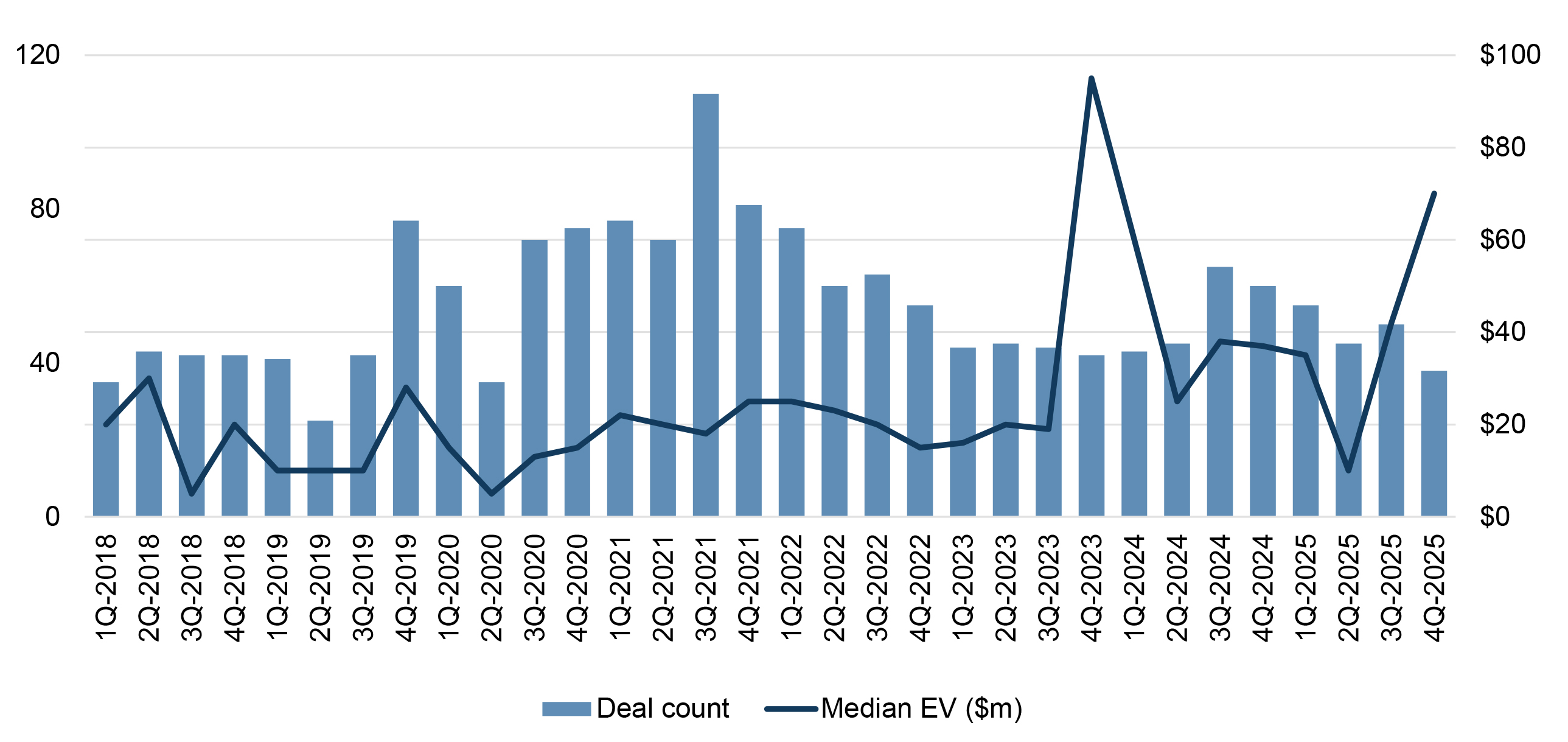
Based on Platform Advisory Partners' analysis of Australia and New Zealand (ANZ) technology M&A deals, deal volumes experienced a modest decrease through Q3 2025 compared to Q1 and Q2, but median valuations climbed more significantly, signalling selective competition for higher-quality assets.
The uplift in pricing reflects relative confidence among buyers – particularly offshore strategics and sponsors – who continue to view ANZ technology assets as attractively valued relative to global peers. This has resulted in a continued trend of ASX-listed technology companies being taken private by offshore acquirers, illustrated by the below take-privates occurring in Q3:
Given the ASX Information Technology Index has recently experienced a moderate pull-back while US tech indexes continue to trade up, conditions are favourable for this trend to continue.
Separately, we expect an uptick of M&A activity in Q4 2025 as dealmakers scurry to close transactions before the new ACCC merger reform regime comes into effect on 1 January 2026.
Platform Advisory Partners is a Melbourne based advisory firm specialising in providing M&A and capital raising advisory services to high-growth and technology companies.
Corrs is a leading Australian independent law firm, with a cross-disciplinary team which has a deep understanding of the needs of startups and high growth companies. We act for both startups and a range of investors, including local and international venture capital funds, strategic investors and universities.
Some examples of venture capital and technology deals we've acted on over the past 12 months include advising CoAct Capital on its investment in EatClub, At One Ventures on its investments in Provectus Algae and Relectrify, Gates Frontier on its investment in Koloma Australia, Stake on its A$90 million capital raise, Five V on its investments in Attekus and iBreadcrumb, Macquarie on its investment in Next Payments, Arrowroot Capital in relation to the sale of HammerTech to Riverwood Capital, GoPro on its acquisition of Forcite Helmet Systems, realestate.com.au on its acquisition of Realtair and Synechron on its acquisition of iGreenData Pty Ltd. Corrs has also recently advised Burda Principal Investments on their investment in biomaterials start-up Uluu and Coinbase on the tax and employment matters associated with their investment in Echo.
Corrs has also developed CorrsEdge, a cutting-edge online platform which gives startups the legal support they need at the early stage of their growth cycle. The platform offers access to over 30 intelligent legal documents with dynamic automation capabilities which enables users to generate bespoke documents and tailor them for their business. The Corrs Edge platform saves time and money, allowing startups to ensure that they have high quality legal documents without the typical costs of using a top tier law firm.


This publication does not constitute legal advice and should not be relied on as such. You should seek individualised advice about your specific circumstances.