Corrs venture capital and tech M&A update - March 2026


Welcome to the March 2026 edition of the Corrs venture capital and tech M&A update, a quarterly publication which highlights recent key developments in the Australian venture capital and tech M&A market and upcoming changes to watch out for.
Kind regards
Corrs Corporate/M&A Team
Cut Through Venture (CTV), in partnership with Corrs, recently released its annual State of Australian Startup Funding Report for 2025. The report highlighted that 2025 saw a sharp rebound in funding across the Australian venture capital market, driven by increased deal scale and renewed investor conviction.
Key capital raising statistics
The Australian startup capital raising statistics in the report show:
Sector perspectives
In terms of sector specific data, the CTV report shows that for Q3 2025:
Investor sentiment and outlook
CTV's investor sentiment survey indicates cautious optimism in the state of the Australian start-up funding market. The survey found that:
More details are available in the full State of Australian Startup Funding Report.
The CTV Report featured a Corrs article titled: "Key legal due diligence risk when investing in AI."
As investor appetite for AI continues to surge, startups across a wide range of sectors are increasingly weaving AI into their fundraising narratives. AI can genuinely unlock growth – for example, a fintech platform might use AI to deliver faster lending assessments, or a Medtech service might improve diagnosis times, while also lowering costs by automating compliance and operational processes. However, investors are sharpening their due diligence to distinguish between startups with a genuine, sustainable AI-driven competitive advantage and those that are simply riding the hype.
Evaluating an AI business means looking under the bonnet of its technology to assess the authenticity of its claims, alongside a careful review of intellectual property (IP) and regulatory risks.
Key diligence priorities:
The practical takeaway is that investors should substantiate AI capability to avoid "AI washing", confirm that the business has sufficient IP rights, and assess regulatory exposure across competition and consumer law, privacy, online safety and relevant sectoral regimes, with reference to responsible AI principles.
Read the full Corrs article on page 44 of the State of Australian Fundraising 2025 CTV Report.
Australia's technology, media and telecommunications sector faces a wave of regulatory reform in 2026, with significant implications for technology companies, start-ups and their investors. As part of these reforms, there are four key areas of change: artificial intelligence, data centres, telecommunications infrastructure, and blockchain and digital assets.
Artificial Intelligence (AI)
On AI, Australia will not introduce a standalone "AI Act". Instead, the government intends to regulate AI through existing legal frameworks, supplemented by targeted interventions focused on specific harms and high-impact use cases. The National AI Plan (published December 2025) sets three priorities: AI infrastructure, economy-wide adoption and skills, and proportionate risk management.
For start-ups deploying AI, the practical takeaway is to assess current AI use against existing consumer protection, privacy and workplace safety laws rather than waiting for broad legislation. In particular, the new transparency obligations under the Privacy Act 1988 (Cth) for automated decision-making take effect on 10 December 2026, requiring disclosure of AI-driven decisions that significantly affect individuals. Organisations should align their AI governance with the National AI Centre's new Guidance for AI Adoption, which is now the core reference for responsible use of AI in Australia.
Data centres
Data centres represent a major investment opportunity, now ranking as the second most preferred alternative asset class in Australia. However, AI is driving a sharp increase in energy demand – AI-ready racks can require up to 80 kW each, compared with around 15 kW for traditional facilities. The Australian Government is developing a national data centre strategy expected to set clear sustainability expectations, including integration of renewable energy and efficient cooling technologies. Operators and investors should prepare for a rapidly evolving regulatory environment prioritising energy efficiency and alignment with national interests.
Blockchain and digital assets
On blockchain and digital assets, the Corporations Amendment (Digital Assets Framework) Bill 2025 introduced in November 2025 is the centrepiece reform. Key features include:
The Bill has a 12-month commencement period after Royal Assent to allow industry transition. Startups and VCs active in digital assets should review their business models to assess whether they fall within the new regime and monitor the Bill's progress through Parliament.
On 5 February 2026, the High Court of Australia unanimously refused to hear an appeal in a landmark case between Aristocrat Technologies and the Commissioner of Patents, effectively settling a years-long legal battle over whether software inventions can be patented in Australia. For technology companies and their investors, the outcome is a significant positive signal: it is now clearly established law that computer-implemented inventions can qualify for patent protection, even if they use conventional, off-the-shelf computer hardware.
The dispute centred on the legal test that should be applied when deciding whether a software invention is patentable. Previously, Australian courts had required applicants to demonstrate an "advance in computer technology", a high bar that effectively excluded many software-based innovations from patent protection. In 2025, the Full Federal Court rejected that requirement and replaced it with a more flexible test: whether the invention produces an "artificial state of affairs and a useful result". In practical terms, this means that a novel idea implemented on a computer to achieve something useful can be patentable, even if the underlying technology is standard.
This is good news for startups building software-driven products. A broader scope for software patents means founders can more confidently pursue IP protection for their innovations, strengthening their competitive position and making their businesses more attractive to investors. For VC investors conducting due diligence, it clarifies the legal landscape and reduces uncertainty around the enforceability of software patent portfolios in Australia.
However, there is an important practical caveat. Despite the court's clear ruling, IP Australia – the government body that actually examines and grants patents – has been slow to fully embrace the new test. Its internal guidelines (the Patent Manual of Practice and Procedure) continue to reference factors from older case law, including whether there is an "improvement in the functioning of a computer" or "ingenuity in the way in which a computer is utilised". While IP Australia has acknowledged the decision and called for stakeholder feedback on updating its Manual, its current practice may still make it harder than it should be to secure a software patent.
In practice, this means that patent applicants may face pushback from IP Australia during the examination process, even where their claims should comfortably satisfy the new legal test. In the worst case, applicants may need to challenge IP Australia's interpretation before the Federal Court. Founders and investors should therefore be prepared for a period of transition and should ensure they have experienced patent advisers who understand both the new legal position and how IP Australia is applying it on the ground.
Read the full Corrs insight article on the High Court decision.
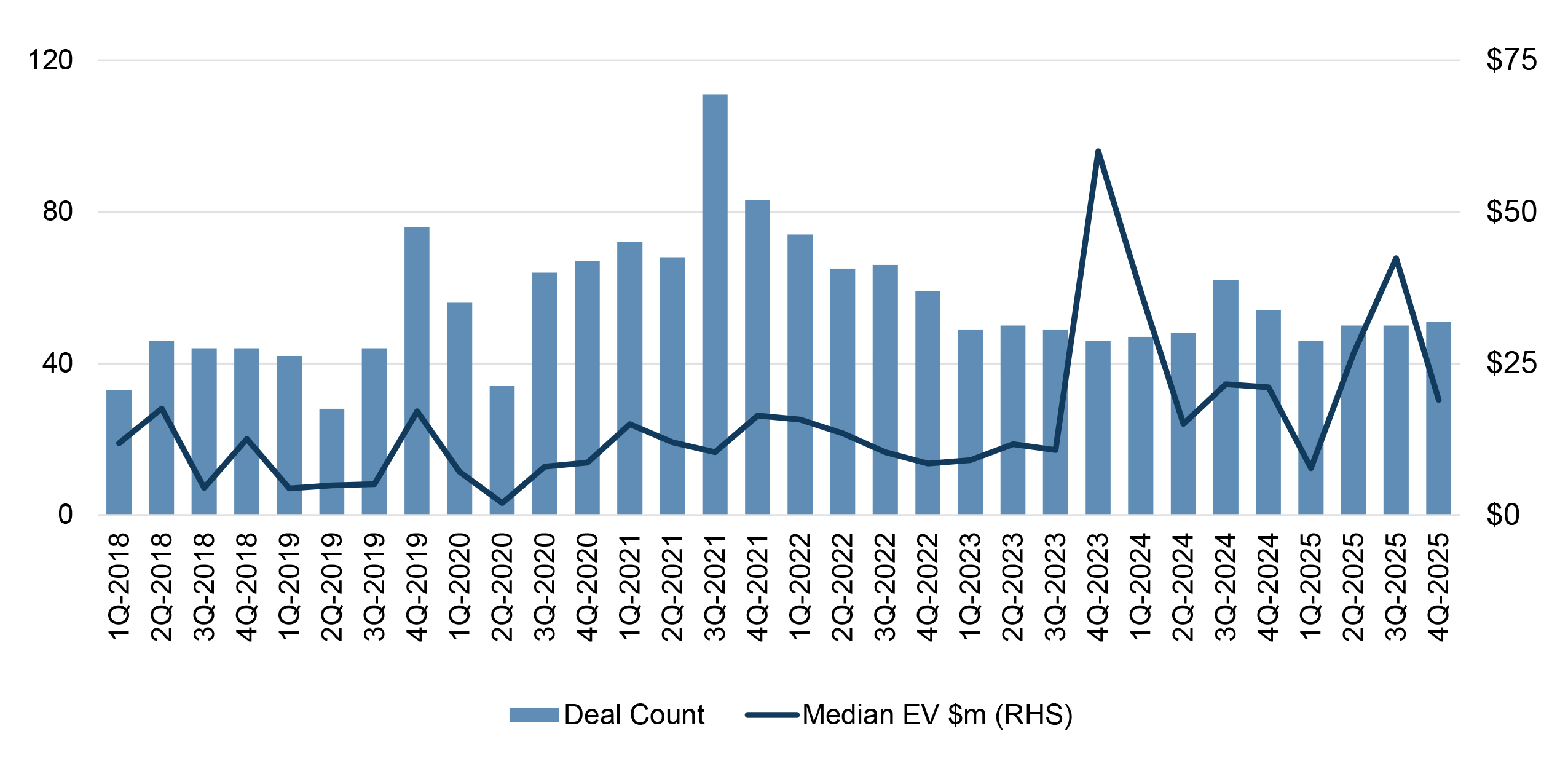
Platform Advisory Partners' analysis of Australia and New Zealand (ANZ) technology M&A deals from Q4 2025 highlights that:
Platform Advisory Partners is a Melbourne based advisory firm specialising in providing M&A and capital raising advisory services to high-growth and technology companies.
Corrs is a leading Australian independent law firm, with a cross-disciplinary team which has a deep understanding of the needs of startups and high growth companies. We act for both startups and a range of investors, including local and international venture capital funds, strategic investors and universities.
Some examples of venture capital and technology deals we've acted on in recent months include advising Accel on its investment in Fluency, CoAct Capital on its investment in EatClub, At One Ventures on its investments in Provectus Algae and Relectrify, Gates Frontier on its investment in Koloma Australia, Stake on its A$90 million capital raise, Five V on its investments in Attekus and 1Breadcrumb, Macquarie on its investment in Next Payments, Arrowroot Capital in relation to the sale of HammerTech to Riverwood Capital and realestate.com.au on its acquisition of Realtair. Corrs has also recently advised Burda Principal Investments on their investment in biomaterials start-up Uluu and Coinbase on the tax and employment matters associated with their investment in Echo.
Corrs has also developed CorrsEdge, a cutting-edge online platform which gives startups the legal support they need at the early stage of their growth cycle. The platform offers access to over 30 intelligent legal documents with dynamic automation capabilities which enables users to generate bespoke documents and tailor them for their business. The Corrs Edge platform saves time and money, allowing startups to ensure that they have high quality legal documents without the typical costs of using a top tier law firm.


This publication does not constitute legal advice and should not be relied on as such. You should seek individualised advice about your specific circumstances.